Saturday, 15 October 2011

Myth-buster 2 - Spot Reduction


So you have a particular “problem area” and want to work specifically on that to lose the fat from around it. Unfortunately, spot reduction does not work in practice. It is a myth pushed by some parts of the industry to help sell their particular new-fangled gadgets. We’ve all seen the ads that promise to get you fit with some new miracle product that has only just come out, and will burn more and more fat from just the right areas in less and less time!

You cannot remove fat from just one area of your body. Otherwise we would all be walking around with six packs! Fat comes off from all over your body through exercise and a healthy lifestyle. It will come off different areas of your body and at different speeds depending on your genetic make-up, so it will be different for everybody.


Forget endless crunches and side leg raises to try and burn fat from your abs and thighs. Instead get your body working aerobically. This means cardio! Move more, for longer at higher intensity to burn more fat. Following on from the previous articles, throw in strength training too. This will help you gain muscle, which also helps to burn more fat. This dual-pronged approach is what will really get the job done.

On top of this, get your foods right. It’s an old saying that you don’t get abs from the gym but from the kitchen. Combine the two elements of exercise and healthy eating and those “problem areas” will take care of themselves.

Let me know your thoughts on this topic below!

Wednesday, 12 October 2011

Saturday, 8 October 2011

Mythbuster - Muscle weighs more than fat?

So does muscle weigh more than fat?

Stating the impossibly obvious; 2.5kg of Muscle will weigh the same as 2.5kg of fat. Just like 2.5kg of steel will weigh the same as 2.5kg of leaves! This much is simple.

But it's not about weight. It's really about VOLUME. Here's why...

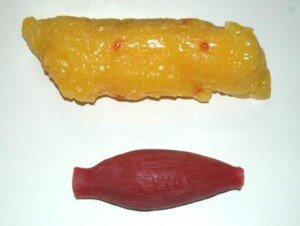
Muscle is denser than fat which means that given the same VOLUME of both, muscle will weigh more when put on the scales. Here is a picture that perfectly illustrates the point.

2.5kg of muscle and 2.5kg fat

As we can see in the above picture, you require a much smaller volume of muscle than fat to tip the scales. So what are we driving at here? 

Well two people can weigh exactly the same (for example 70kg) but their body compositions can be very different. One could have more lean muscle mass and the other a much higher percentage of body fat. The person with more lean muscle mass will look much smaller and healthier than the other, as muscle takes up less volume as we discussed above. Apart from this, many other benefits of having lean muscle mass have been discussed in my previous post.

So in conclusion, the scales are not the be-all and end-all of your fitness levels. Much more important is your body fat percentage vs lean muscle mass. These changes you can see in the mirror (I'd recommend taking photos on your fitness journey to record your progress) and can feel in how well clothes are fitting etc as well as having measurements done by a professional.


Saturday, 1 October 2011

5 Reasons to lift weights (ladies...you too!!)


1. Increase Functional Strength

Muscles help us to perform functional everyday activities. By doing resistance training in a functional way you will increase the strength of these muscles and be able to perform daily activities with less effort on your part! The upshot - more energy throughout the day.

2. Increase or Maintain Lean Body Mass

As we age our muscles waste away (called atrophy) at a rate of around 0.5Kg per year after the age of twenty. Strength training can stop or indeed reverse this process.

3. Burn Fat 

For every 0.5Kg of muscle you put on you can burn an extra 50-100 calories per day. Without doing anything! Speed up your metabolism by hitting those weights!

4. Decrease Risk of Injury

The joints of the body are supported by your muscles - acting much like the strapping that athletes use around their limbs. Increasing the functional strength of your muscles will increase the support they give to your joints and therefore decrease the possibility of injury.

5. Decrease the risk of Osteoporosis

Osteoporosis is a disease that breaks down bone. Approximately 1 in 3 women and 1 in 8 men will suffer from this condition. Strength training will cause the bone to lay down more minerals increasing the mineral density due to the stresses placed on the bone by lifting weights. This leads to replacing the bone minerals and thus slowing down bone degeneration. 


So there you have it, just five of the many reasons that lifting weights is good for you. Just a quick note; to cause hypertrophy (muscle growth) you need to lift heavier weights with fewer reps. This mainly goes out to the ladies - don't be scared to lift heavy. You will never bulk up like a man...you don't have the testosterone levels for that to happen.

Friday, 30 September 2011


Had a moment like the start of this video yesterday. Went for what was only supposed to be a quick run and just got that feeling to keep going. Setting myself places to run to, getting to them, and then deciding to just keep going. This scene immediately came to mind and inspired me to keep going further and further. Needless to say feeling very sore today but can't wait to get out running again.

Wednesday, 28 September 2011

"The best workout program is the one that you can stick to."

Tuesday, 27 September 2011

Family Guy paves the way for PTs everywhere!

"Our health always seems more valuable after we lose it" - Unknown

Obesity Epidemic!


Obesity rates have blown out to record levels. Obesity and a rise in chronic disease is costing Australians over $58 billion annually (ABS Year Book Australia 2009-2010) – which equates to over half of our total healthcare expenditure. The cost is expected to rise as Australia continues on a trajectory of increasing chronic disease and obesity related conditions.
Picture the Future of Australian Healthcare
The research into the future of Australian healthcare, commissioned by Siemens, was released today in Sydney to coincide with World Health Day. The findings indicate that if the current trend continues, over 75 percent of our population could be overweight or obese by 2030 (National Preventative Health Taskforce, 2009).
Jodie Long, Senior Researcher for Picture the Future says that in order to reverse this alarming trend, the research, for the first time, has looked at the incidence of chronic disease combined with the increasing trend of an ageing population. “This is the first time that research has looked at the underlying challenges we face both with the epidemic of obesity and the resultant chronic diseases it causes – such as diabetes, heart disease and cancers – combined with a significant change in our population demographics. By 2030, 20 percent of the population will be aged 65 or over which will further exacerbate our healthcare challenge and only highlights the urgency in addressing these challenges into the immediate to mid-term,” said Ms Long.
Preventative Approach
In Australia we currently spend nearly 98 percent of our total health expenditure on treatment and care and only 2 percent on prevention (Australian Institute of Health and Welfare, 2010).“Prevention is critical to our ability to deal with chronic disease. We need to invest significantly more in the area of prevention and research to bring down obesity levels and reduce the incidence of chronic disease,” said CSIRO’s Professor Richard Head, who provided feedback on the research.
Siemens worked with more than 40 partners to compile the research and found if the tide of disease is to be reversed, the focus must be on early detection and new and innovative ways to predict the health of Australians. “Technology has the potential to play a huge role in reducing the incidence of these types of diseases in their early form.  If we can accurately and quickly pick up illness through personalising our healthcare via a ‘virtual human model’ or a ‘lab on a chip’ – we’ll start to see a real change,” said Ms Long.
Picture the Future
Futuristic technologies, currently in the R&D phase, model the human heart and organs to produce a simulated result. Lab on a chip can accurately detect via a drop of blood how diseases may manifest themselves before they even start. “We see these technologies as a real step forward in safeguarding our country against chronic disease and making Australians personally responsible for the future of their own health,” added Ms Long.

What happens when your body shuts down...


Both hilarious and inspirational at the same time! Not many times you can say that.